Jirga News.
Noblesse Oblige notes that cross-border tribal jirgas between Afghanistan and Pakistan have begun and this probably marks the beginning of a process which will culminate in the forthcoming jirga which the Afghan and Pakistan presidents are expected to attend. The Pakistani Daily Times also carries the story.
Afgha.com has an article locating both the jirgas and the fluid Afghan-Pakistan border in an historical context, from the days of the Great Game.
A Border That Does Not Exist. Dr. G. Rauf Roashan
Tags:The Afghan government’s proposed meetings with tribal chieftains on the Pashtun belt in an area around an arbitrary border line, if successful would be of significant importance in dealing with a variety of issues. It would restore, to some degree, the popularity of the Afghan President that has recently and gradually eroded due to a variety of reasons among them deteriorating security situation, lack of luster in reconstruction efforts, slow pace of nation building exercise and a slower pace of building up of military and police force. Afghanistan as well as many international sources have claimed that part of the reason for increased violence in Afghanistan is the fact that terrorists are allowed to infiltrate Afghanistan from neighboring Pakistan. This article tries to shed light on the history of the region, its political significance and some expectations from the meetings emphasizing the need for a thorough preparation prior to the actual meetings.
There is a long stretch of land extending from the peaks of Western Himalayan Branches near Pamir to the southwest all the way to the Solomon Mountains and the dry deserts of the Siestan Basin in southwestern Afghanistan. The area is located on the western bank of the famous River Indus that originates from the northeastern peaks of the mountain range that extends its many arms into what are Pakistan, Kashmir, China and eventually Nepal farther east at the foot of Mount Everest.
Pashtun tribes, who have flourished in the confines of the mountains and their harsh geography for thousands of years, populate for the most part, the area between Pakistan and Afghanistan. Historically the area was part and parcel of Afghanistan specifically after Ahmad Shah Abdali, founded one of the most unified governments in Afghanistan in 1747 which makes even the new Afghanistan, 29 years older than the United States of America. Then Afghanistan was much larger in size consisting parts of eastern Iran, the whole area of Pakistan today including Kashmir and even extended to Delhi, which is the capital of India today.
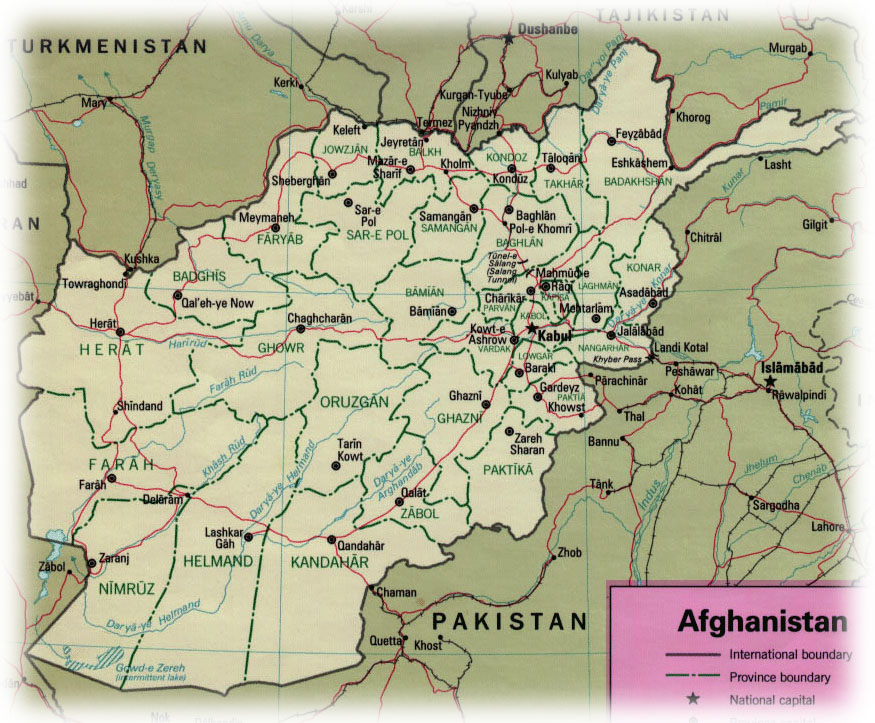
The British occupation of India prompted Great Britain to attempt conquering Afghanistan and using it as a strong gate against invasions from the north by Russia. Three Anglo-Afghan wars convinced the British that Afghanistan was a land that could and was used by many but was conquered by none. Therefore it played all its cards and used all its expertise in the management of its colonies upon which the sun never sat to limit the Afghan independence by manipulating its administration, its power thirsty princes and kings and kingpins. In addition it tried successfully to cut limbs from the body of the land of the Afghans and finally when Britain had to leave the sub-continent in 1947, it provided for giving of the cut parts of Afghanistan to the artificially created country of Pakistan. To do this it relied on one of her previous efforts when during the reign of Amir Abdul Rahman Khan she had deputed Sir Motamer [ie. Mortimer- HB] Durand from the British Indian Foreign Service to draw a line separating the land of the Afghans, mostly in an arbitrary manner, in 1893 from what was then the British colony of India. The line originally drawn was to be in effect for 100 years. Historically the line did not receive the blessing of any Afghan legislature and was never recognized officially by successive Afghan governments. The newly created Pakistan counted on this imaginary line as its official border with neighboring Afghanistan while in practice even today many parts in the area are called as semi-autonomous districts and are accorded administrative freedom by the government of Pakistan.
Yet, on paper the line existed and arbitrarily defined jurisdiction of the Afghan government in relation to those of the semiautonomous regions called by many names among them Pashtunistan, Pashtunkhwa , Northwest Frontier and Free Border. It never functioned as a true border between two countries. For example at a so-called crossing point from Nangrahar Province in Eastern Afghanistan into Northwest Frontier there was, as it still is, a bridge over a dry creek on each end of which sentries in different uniforms keep a semblance of a gate. While travelers wait for the gates to open for the passage of vehicles, you can always witness a stream of pedestrian passengers sometimes together with their beasts of burden walking under it to either side, unhindered by any soldier or civilian employee of either government.
In actuality there is no border between Afghanistan and what is called Pakistan today. People on either side of the arbitrary line belong to the same families. Parents and children, and siblings living on both sides continuously traverse the area unaware of borderlines and or artificial barriers. However, the area in general has gained more importance recently because in some of the regions Pakistan considers its land, she has allowed, by a treaty, freedom to chieftains who allow extremist elements freedom to received training and organize for a so-called jihad against the government and people of Afghanistan. Although Pakistan claims that the treaty signed in return for the tribal chieftains not attack government military establishments, and that according to Pakistani government it will prevent excursions by extremists into Afghanistan, yet conditions on the ground show considerable liberties taken by Pakistani Taleban and their Madrassa students including some from Afghanistan to propagate extremist tendencies and even to adopt extremist justice free of the Pakistani legal system.
Now Afghanistan and its president whose popularity is gradually eroding due to a lack luster claim on reconstruction, deteriorating security situation and lack of significant political achievements, have a chance to meet in traditional jirgas or tribal meetings with tribal chieftains of this traditionally independent area and to make a case so that the Pashtun motherland and generally all Afghans are safeguarded against imported terrorism.
The meeting scheduled for December 2006 or January 2007, may bring some semblance of a direction in efforts to deal with this age old regional problem and would tackle also the issue of the otherwise expired one sided document called the Durand Line.
President Karzai would need a coherent and orchestrated planning for the meetings to expect desirable results. He needs a more active, resourceful and experienced diplomatic input for the preparations. He needs to meet beforehand with representatives of the people of Afghanistan, Afghanistan’s intelligentsia, Afghan international affairs experts, and even some relevant United Nations system authorities. President Karzai should make sure that undesirable personalities that do not enjoy the confidence of the nation should not find their way as members of his delegation to these talks. On the other hand, he would need on his team enlightened reputable religious leaders who would be able to interpret religious tenets, denounce extremism, suicidal violence and the killing of innocent Moslems including women and children and the need for unity for the followers of the Islamic faith so that it would further prosper.
Such a team would also have the task to regain the international prestige and honor due the sacred Islamic faith and which prestige has been damaged by futile extremist activities that make little sense to the world public.
The meetings called “Jirgas” in their traditional connotation, should also make an effort not only to bring peace to the region but also to provide for expanding of social and economic services to the Pashtun belt living around an arbitrary border line in a border region that in reality does not exist.