Showing posts with label Afghanistan. Show all posts

10 May, 2007

Taliban Spring Offensive IV.

Afgha.com continues Chronicling the Spring Offensive, with Part IV covering April 19 - May 8. Once again the, by now, familiar pattern emerges of isolated suicide bombings which, although potentially deadly, are much less dangerous than the frontal attacks of last year.

A significant strand to emerge from the chronicle is the Taliban's targeting of Afghani policemen. Otherwise, it seems pretty much a continuation of previous activity.

Afgha.com also highlights the use of mentally and physically handicapped individuals as suicide bombers.

19 April, 2007

Iranian arms for the Taliban.

US government officials have finally gone public with one of the least surprising revelations of the week: that Iran is supplying arms to its former enemies in the Taliban. I call it the "least surprising" because it is such an obvious way to attack the west in general and the US and the UK in particular. Iran may have little reason to fear any responses. US policy seems to be increasingly hamstrung by Congress and the UK looks disturbingly irrelevant after the Royal Navy's recent humiliation. Moreover, Iran's recent triumphs through Hizballah in Lebanon will have probably have impressed the Tehran terrorists with the potential benefits of fighting wars by proxy.

The International Herald Tribune reports on the revelatory remarks of Marine Gen. Peter Pace, chairman of the Joint Chiefs of Staff. The Baltimore Sun also weighs in. Sadly, the British press does not seem to be very interested in a development which could pose a major danger to British troops. I can find coverage only in the Guardian.

18 April, 2007

Chronicling the Taliban spring offensive 3.

Part Three of Afgha.com's chronicle of the Taliban's spring offensive, covering the period between 28 March and 18 April, is now available. Links to Parts One and Two can be found here.

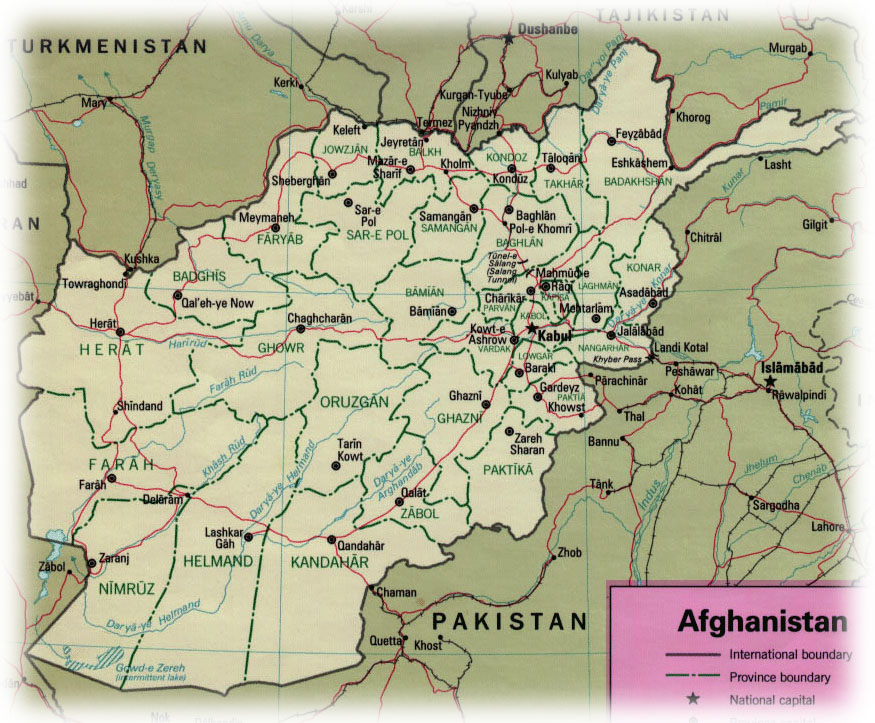
From the Taliban, it is the largely, by now, familiar pattern of isolated, nonetheless lethal, small scale attacks. The ISAF seems to have continued its precision attacks on Taliban leadership and to have launched its own spring offensive, with a major assaults around Sangin (see, 6-7 and 15-16 April) and Garmsir (13-14 April). It looks like the pattern may be set for the immediate future, possibly for at least as long as the Taliban forces in western Pakistan are tied up consolidating their position there by hammering al-Qaeda's Uzbeks.

Over the coming months, the key places in Helmand to watch will probably continue to be: Sangin, where the prize is control of the economically vital Kajaki hydro-electric Dam; Garmsir, which is the "Taliban gateway to Helmand" from the Taliban's strongholds to the east in Pakistan; and Musa Qala, the importance of which, after last year's controversial British-Taliban truce, is probably as much symbolic as strategic.

17 April, 2007

Cricket in Iraq and Afghanistan

More news that you are unlikely to come across in the msm. In Basra, the British Army has been introducing Iraqi children to the noble game through Kwik Cricket, a flexible form of the sport developed by the England and Wales Cricket Board in consultation with educationalists mainly for use by children from the age of 5 in primary schools. Both the Ministry of Defence and the ECB have reports.

The splendid Major Andrew Banks, who never deploys without his cricket bat, also ran a similar scheme in Afghanistan last year. He told the ECB that the Iraqi children had little concept of bat and ball games and they "... never quite understood the lbw law but they enjoyed themselves and that was what mattered." No problem. I have known umpires who never understood the lbw law either.

Last year the Afghan national team played its first match against the MCC, as result of which two Afghans were invited to join the MCC Young Cricketers and later in 2006 the Afghans toured England, playing at quite a good standard against county 2nd XIs.

Operation Achilles in Helmand.

Operation Achilles, the ISAF's major anti-Taliban offensive in Helmand, Afghanistan has been continuing this week with series of joint Afghan-British strikes targeted against terrorist leaders in the north of the province. According to an ISAF press statement:
... in joint operations with Afghan National Security Forces (ANSF), ISAF launched a series of attacks and precision strikes against Taliban extremist in the Northern Helmand this week resulting in the elimination of several key extremist leaders from the ongoing insurgency.

“Striking at the heart of the problem and removing these key leaders has paid off,” stated Major General Ton van Loon, Commander of Regional Command South. “We fully realize the influence these Taliban extremist leaders have on the population of Southern Afghanistan who have clearly told us they felt like they where hostages in their own communities. Removing these extremist leaders from the equation allows freedom of choice to young men who are otherwise intimidated and coerced to join the Taliban extremists in the South,” he added.
Afgha.com summarises the latest state of play in the province with useful links to contextual material. Basically, a mixed picture emerges with ISAF success in retaking control of Sanguin being offset by continuing Taliban dominance of the Musa Qala, Now (New) Zad and Bagrhan districts. Afgha.com concludes that,
The recent offensive launched by NATO against the Taliban militants holed up in Helmand [Operation Achilles] is likely the beginning of a summer long campaign aimed at securing the Kajaki dam complex in northern Helmand and securing the ring highway (highway 1) that cuts through Afghanistan’s southern underbelly, stretching from Herat to Kabul.
The BBC has a few earlier pictures from Operation Achilles.

Tags: , ,

16 April, 2007

Private Chris Gray. (Updated)

The Ministry of Defence has announced the 53rd British fatality in Afghanistan: Private Chris Gray, 19, of the Royal Anglian Regiment, has been killed in a Taliban ambush at Now Zad, Helmand, Afghanistan.

Private Gray's routine patrol,

...was attacked by the Taliban; employing small arms, heavy machine guns, rocket propelled grenades, mortars and rockets.

As lead elements of the patrol were pinned down by enemy fire, Private Gray’s Platoon manoeuvred to support their comrades and out-flank the enemy. Private Gray was the point man in his Platoon – selected for this position as a result of his outstanding soldiering skills.

As they manoeuvred, Private Gray’s section observed a group of armed Taliban fighters at close range, whom they immediately engaged. A fierce firefight ensued at a range of just 15 metres, during which a small number of Taliban were killed.

Tragically, during the battle Private Gray was shot and despite the best efforts of his colleagues and medical staff was pronounced dead on arrival at the British Hospital at Camp Bastion.
The MOD obituary says that,
...Private Gray joined the British Army in March 2006 and, having completed training as an infantry soldier at the Infantry Training Centre Catterick, he joined the 1st Battalion The Royal Anglian Regiment in September 2006.

He was born in Leicester and attended the Holmfirth School in Huddersfield. Among his many interests he had a love of outdoor life and was a keen snowboarder.

Private Gray has two younger brothers and a younger sister. He was a former pupil of Ratby Primary and Brookvale High Schools, and later attended Groby Community College, Leicestershire.
More from the BBC and the local press in Huddersfield and in Leicester.

Update: Life and Death on the M*A*S*H Shift: the Guardian has a moving account from Helmand of Private Gray's death in the context of the army medics who treated him.

10 April, 2007

Road race in Kandahar.

Here is a story the main stream media seems not to have picked up on: a 10km road race has been held through the northern part of Kandahar City, previously the scene of fighting between NATO forces and Taliban. The event attracted 500 runners and no exploding roadside devices or terrorist ambushes.

Despite the obvious continuing, serious problems from isolated suicide bombers, the Canadians' ISAF Provincial Reconstruction Team is making a difference in the province. Somebody tell the msm.

08 April, 2007

Afghanistan: the Taliban Spring Offensive.

Afgha.com has started a chronicle of the Taliban's spring offensive in Afghanistan, which makes a useful reference:

Chronicling the "Spring Offensive".


Chronicling the Spring Offensive II: March 13-25.

Click to enlarge.


Afgha.com also has a detailed account, with links, of the deteriorating situation in the previously relatively peaceful Farah province.

I must admit that, having relied on the British printed media for the past few months, I had no idea the position was now potentially so bad in western Afghanistan, in the province next door to the British forces in Helmand. Recently, a number of serious incidents have occurred in Farah, including the murder by the Taliban of seven Afghans working for a US company, 22 arrests, including six teenagers, for bomb-making at a madrassah and a devastating roadside bomb attack which killed ten Afghan policemen.


19 February, 2007

British troops again in action at Garmser.

On Sunday, in Operation Glacier, Afghan artillery was used for the first time in an ISAF operation, as coalition forces attacked a Taliban stronghold near Garmser (Garmisir), Helmand, the scene of fierce fighting in the autumn. After consulting the local elders, over 150 British troops attacked and destroyed three terrorist compounds and a series of linking tunnels. No British or Afghan casualties were reported. No enemy casualty figures were given.

Lieutenant Colonel Rory Bruce, spokesman for the UKTF, said: “Op GLACIER marks the continuation of our recent operations in and around Garmsir to strike at Taliban extremist targets and command centres.

“With the first use of Afghan artillery, it also marks a significant step towards enabling full combat capability for the ANA and, ultimately, to Afghans being able to provide security for themselves,” he said.
Source: ISAF News Release

As far as I can discover, so far only the Bulgarian Focus News thinks the incident worth reporting. A damning indictment on the British mainstream media.

16 February, 2007

That dam Taliban.

In Helmand, Afghanistan, NATO is continuing Operation Kryptonite, its attempt to clear the Taliban from around the Kajaki dam.

The New Zealand Herald, carries a Reuters, India report that the Taliban have been using children as human shields to escape NATO forces.

The Independent has an on-the-spot report on the fighting.

The Daily Telegraph publishes an account of an earlier action at Kajaki by a film maker spending a year with the Royal Marines.

15 February, 2007

President Bush on Afghanistan.

President George Bush has been addressing the American Enterprise Institute on the Global War on Terror. Click here for the full text of his remarks. The President referred to Iraq but the bulk of his remarks concerned Afghanistan, on which he outlined a five point strategy for NATO forces. The strategy is summarised here as:

  • increase the size and capabilities of the Afghan security forces;
  • strengthen NATO forces in Afghanistan;
  • improve provincial governance and help develop Afghanistan's rural economy;
  • reverse the increase in poppy cultivation that is aiding the Taliban;
  • fight corruption, especially in the judicial system.
With regard to NATO the president called on member states to provide more troops and to allow their troops to be deployed whenever and wherever, required by commanders on the ground.
For NATO to succeed, member nations must provide commanders on the ground with the troops and the equipment they need to do their jobs...

... when there is a need, when our commanders on the ground say to our respective countries, we need additional help, our NATO countries must provide it in order to be successful in this mission.

As well, allies must lift restrictions on the forces they do provide so NATO commanders have the flexibility they need to defeat the enemy wherever the enemy may make a stand. The alliance was founded on this principle: An attack on one is an attack on all. That principle holds true whether the attack is on the home soil of a NATO nation, or on allied forces deployed on a NATO mission abroad. By standing together in Afghanistan, NATO forces protect our own people, and they must have the flexibility and rules of engagement to be able to do their job.
I doubt he will meet with an enthusiastic response from our so-called allies in NATO.

Dam Taliban strike back.

The Taliban have struck back at the Kajaki Dam project, in Helmand, Afghanistan. The Royal marines had retaken and secured the area around the dam, so that the contractors could resume work. However, work on the project has now been halted, again. The terrorists fired 14 "cheap rockets" in the general direction of the dam; consequently, the US contractors were pulled out by their company, USAid, leaving behind some not very impressed Royal Marines and Afghan civilian workers.

Anthony Loyd, the Times' man at Kajaki has the story.

14 February, 2007

The latest from Kajaki: Operation Kryptonite.

The ISAF has released a statement on how the Taliban were removed from some areas around Kajaki in Operation Kryptonite. It is good to see the British army retaining a sense of humour in such circumstances.

A small part of the operation is described in the Times, which had a correspondent with the Royal Marines in the Kajaki dam area.

The ISAF has also released a brief statement telling how a rocket attack at Kajaki was dealt with.

Previously on Crumbling Spires: Taliban build-up in Helmand.

13 February, 2007

The Royal Marines battle for Kajaki Dam.

The battle for the Kajaki dam has kicked off, again. The Daily Telegraph quotes official reports that Royal Marines, supported by artillery and Afghan forces, fought a 12 hour battle. No NATO casualties are reported, but a "several" terrorists are said to have been killed. According to the Times, the Taliban have been routed.

Update:

Reuters, India says that 300 ISAF troops were involved in the operation , which involved clearing 60 compounds from an area used recently to launch regular mortar attacks.

11 February, 2007

Taliban build-up in Helmand.

The BBC reports that that it has been told by Haji Asadullah Wafa, the new governor of Helmand province, southern Afghanistan, that 700 insurgents (ie Taliban terrorists) have entered Helmand with the aim of attacking British troops protecting a major dam project.

The BBC does not name the dam but presumably it is Kajaki hydro-electric dam, from which the Royal Marines ejected the terrorists in early January. It is also the area where Corporal Mark Wright of the Paras was awarded the George Cross last July.

The International Herald Tribune carries a numerically similar Associated Press report that 700 "foreign fighters" (the Taliban's foreign legion to the rest of us) from Chechnya, Uzbekistan and Pakistan are in the area around Musa Qala where negotiations to peacefully remove the Taliban are apparently still underway.

Little is to be gained from a detailed analysis of the numbers of terrorists in parts of Helmand given by these press reports. They may be correct , they may not. We can only trust that NATO has its own accurate intelligence, which is not for public consumption. The key point is that the Taliban seems to be moving its forces into Helmand in preparation for the expected spring offensive which may kick off any time now.

08 February, 2007

Afghan-Pak border arguments continue.

Afghanistan and Pakistan are continuing their exchange of diplomatic un-niceties. The latest Afghan salvo was delivered by Said T. Jawad, their ambassador to the United States. The Wall Street Journal is subscription only, but the Daily Times reports that in an article in the Journal, Jawad warmed up by writing that National Intelligence Director John Negroponte had told the Senate Intelligence Committee that Pakistan is: “a major source of Islamic extremism” and "that Al Qaeda leaders enjoy a “secure hideout” in Pakistan, while rebuilding their terrorist network and pursuing WMD." Jawad went on to aver that "terrorist sanctuaries in Pakistan are the real threat to regional stability and global security. Such sanctuaries are breeding grounds for extremism and violence”; however, Pakistan's proposal to mine the border is not the answer because it will kill innocent civilians whilst doing nothing to stop the terrorists.

Associated Press of Pakistan reports that Pakistan is going ahead with the plan to mine the border and quotes a letter from the Pakistani Ambassador to the the UN which lays the blame for the Taliban problem with Afghanistan. Moreover:

Ambassador Akram said that security in Afghanistan is threatened by multiple threats from warlords, criminals, the drug mafia, inter-tribal rivalries as well as the resurgence of the Taliban.
He said that along the 22 frequented border routes where Pakistan maintains border posts, over 40,000 persons and 14,000 vehicles cross the border every day in both directions. Pakistan, he said, is planning to gradually regulate movement across the international border while respecting the 'easement' rights traditionally enjoyed by the tribal population on the two sides. He expressed the hope that the Afghan government will extend cooperation to ensure better regulation.
By now, this is familiar stuff, from both sides.

Musa Qala: General McNeill's first test. (Updated and revised)

Last September, Brigadier Butler, the British task force commander in Afghanistan agreed a truce, brokered by village elders, with the Taliban at Musa Qala in Helmand province, the scene of some of the fiercest fighting in Afghanistan.

Earlier this week, the Taliban retook Musa Qala, a move which Afgha.com interpreted as possibly heralding "the start of an offensive by the Taliban in order to preempt NATO reinforcements that are arriving in southern portions of the country."

The ISAF responded with an air strike in which the Taliban commander in Musa Qala, Mullah Abdul Ghafoor, was killed. The ISAF say the operation was a precision strike intended to remove Ghafoor.

People's Daily Online quotes an ISAF spokesman as saying that the ISAF will assist government forces to retake the town. For the moment, however, the Taliban remain in control. According to the Pakistani Daily Times, the Afghan government is attempting to negotiate a peaceful withdrawal.

The Institute for War and Peace has eye-witness accounts of the take-over and reports that the remaining inhabitants are bracing themselves for an expected NATO assault. So far, the Daily Times says, the IASF has only dropped leaflets warning the Taliban to leave the area.

We wait to see what the ISAF's next move is. It will be US General General Dan McNeill's first major test since taking rotating command of ISAF forces. General McNeill is expected to take a hard line with the terrorists.

Over at the The Fourth Rail, Bill Roggio has more.

07 February, 2007

NATO "reinforcements".

Germany is sending six reconnaissance jets to Afghanistan to undertake some Taliban hunting, reports Spiegel Online. It is a welcome start in providing the forces NATO needs but it is not clear if the aircraft will be allowed to fly any combat missions.

Defense Minister Franz Josef Jung said the Tornados would offer added protection for the ISAF troops and Afghan population. "Reconnaissance isn't combat," he told a news conference after the cabinet meeting on Wednesday.
According to Deutsche Welle the German government has not ruled out the possibility of the planes being used to provide combat support for ground forces. However, neither have they ruled the possibility in.

Meanwhile, as the International Herald Tribune reports, later this week Robert Gates, US Defense Secretary will make his NATO début in the futile game of trying to persuade the recalcitrant Europeans to provide more resources for Afghanistan. He will, of course, come away disappointed. If Gates does not know already that NATO is useless for its purpose, I suspect he will learn shortly.

02 February, 2007

Extra troops for Afghanistan?

Little seems to have changed since I last posted on Afghanistan. NATO's ISAF continues to take on the Taliban in a series of fierce, but isolated, engagements, especially in Helmand and Kandahar provinces. The strategy seems to be to reduce Taliban capabilities before the terrorists launch their widely expected spring offensive.

Probably also with the spring offensive in mind, the United States and the UK are increasing troop levels in the country. Yesterday, UK Defence secretary Des Browne announced another 800 troops, many of which appear to be reservists. According to Reuters, the actual increase, taking into account redeployments throughout the province, will be about 300, so it sounds as if the announcement is largely cosmetic and will not lead to a significant increase in combat troops.

It looks like the British Army will yet again be sent into battle under-manned and ill-equipped. Little seems to have changed since I first posted on Afghanistan.

07 January, 2007

Royal Marines in action in Helmand.

Up till this week, the ISAF had a problem with the Taliban, who were were preventing them carrying out repairs to the Kajaki hydro-electric dam in Helmand. Not any more, after about 11o Royal Marines from 42 Commando launched Operation Clay and persuaded the Taliban to leave their training camp in the area. It took four days of intense fighting, but Operation Clay has been a success. Only one British casualty, a marine shot through the hand, against at least 15 dead Taliban, including a senior commander. The BBC and the Guardian have early British press accounts.

The Hindustan Times reports that a further three Taliban departed for Paradise earlier than expected when a mine they were laying blew up. Once there they no doubt met up with 17 of their comrades dispatched from the Kajaki area earlier in the week.

So about 38 Ali Babas get their virgins and the greater part of 2 million Afghans at last get electricity. A fair trade.